

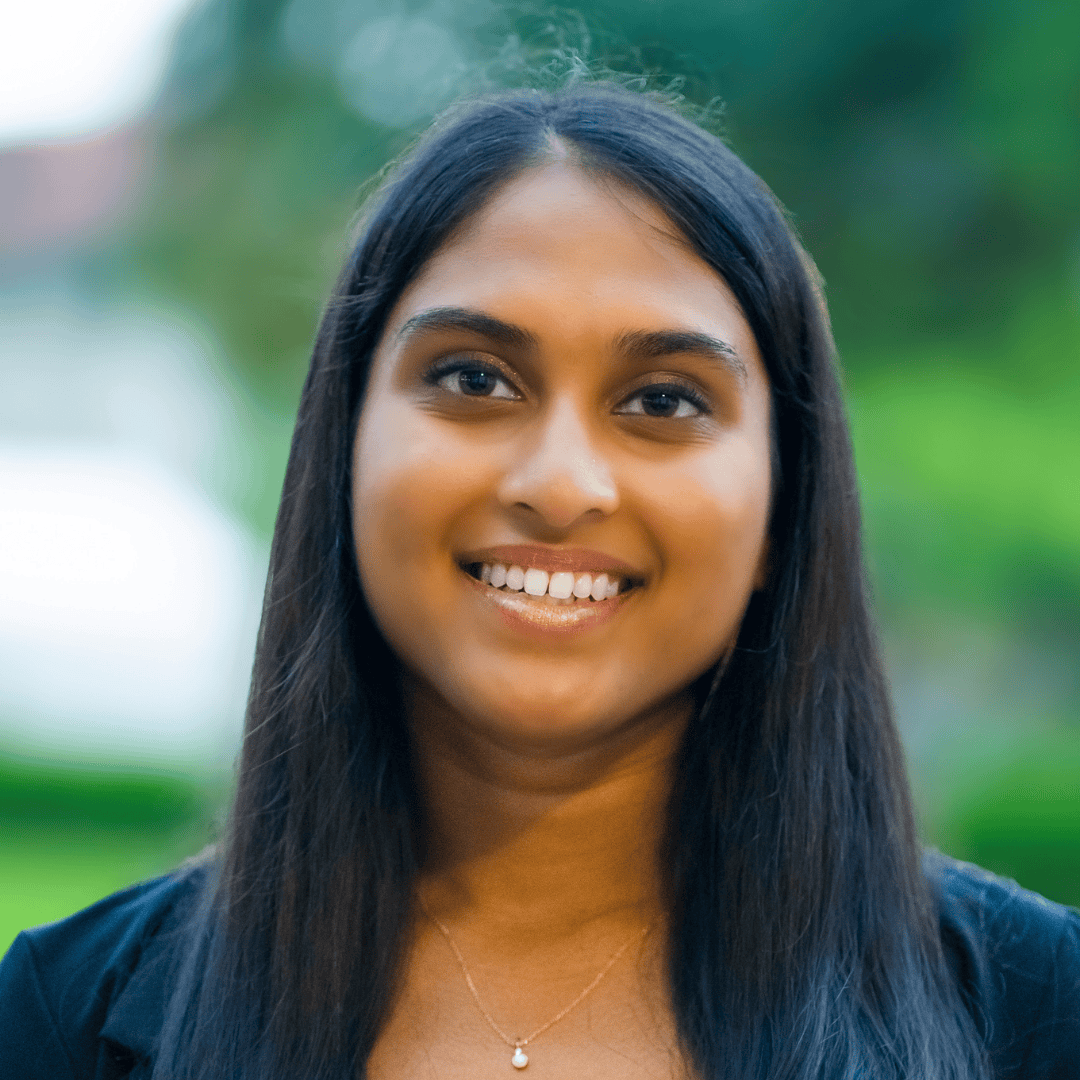
During her undergraduate studies at the University of Texas at Austin, Sanhita Chundury became increasingly aware of the intersection between health data and artificial intelligence (AI). A neuroscience major, she minored in applied statistical modeling; social equality, health & policy; Spanish for the medical professions; and pre-health professions. Sanhita expected that AI could potentially improve information delivery throughout the health care industry. Moreover, she wanted to find new ways to reduce barriers to health care access. Sanhita recently graduated from the MS in Health Informatics program at Weill Cornell Medicine (WCM), where she transformed her interdisciplinary interests into a career path.
When searching for a master’s program, Sanhita knew she was passionate about health informatics as an individual discipline. “A lot of programs group health informatics and data science together. Since the programs at WCM are distinct, I was able to tease out what I wanted to focus on,” she explained. “The MS in Health Informatics program had also formally launched an AI pathway, and I was really looking for programs with that cutting-edge focus.”
Though many courses in the MS program were impactful, Sanhita particularly enjoyed the AI in Medicine class taught by Dr. Fei Wang, associate dean for artificial intelligence and data science at WCM, director of the Institute of Artificial Intelligence for Digital Health, and professor of population health sciences. “We frequently examined research from Dr. Wang and his peers and critiqued how AI was used,” Sanhita said. “In doing so, we learned about interpreting methods of AI in research, and whether the results AI provided were justifiable. It pushed us to think creatively and critically about the subject matter.”
For their final project in Dr. Wang’s course, students developed novel AI pipelines. With a partner, Sanhita conducted a clustering analysis on Alzheimer’s subtypes, determining whether handwriting could be a predictor for Alzheimer’s disease. “Dr. Wang’s expectation for the quality of work we delivered allowed me to explore frontiers I never imagined I’d be exploring. His feedback encouraged us to be the most informed we could be, enter the workforce as experts, and speak with gravitas.”
The capstone project she completed was similarly enriching. Sanhita worked with an industry partner on optimizing a natural language processing (NLP) pipeline for detecting protected health information from deidentified clinical documentation. The process served as a deep dive into NLP and helped her hone the type of work she seeks to do in the future.
As she finished her degree, Sanhita served as a data science and AI intern at a maternal health startup, which, in line with Sanhita’s goals, aims to improve access to maternal health care. She helped formulate an automated billing process to improve the overall workflow of the services provided.
Sanhita was recently hired as an AI research analyst with JPA Health, where she is excited to begin her career at the intersection of health, data, and business. In her new role, she will leverage advanced AI and diverse datasets to conduct secondary research. Reflecting on the MS program, she’s grateful for the meaningful collaboration and guidance she experienced.
“You get out of the program what you put into it,” Sanhita said. “Listening to the professors and guest speakers that come in is so valuable; it’s otherwise rare to be in the same rooms as them and to ask questions about their work. They are there to support you and share opportunities.”