

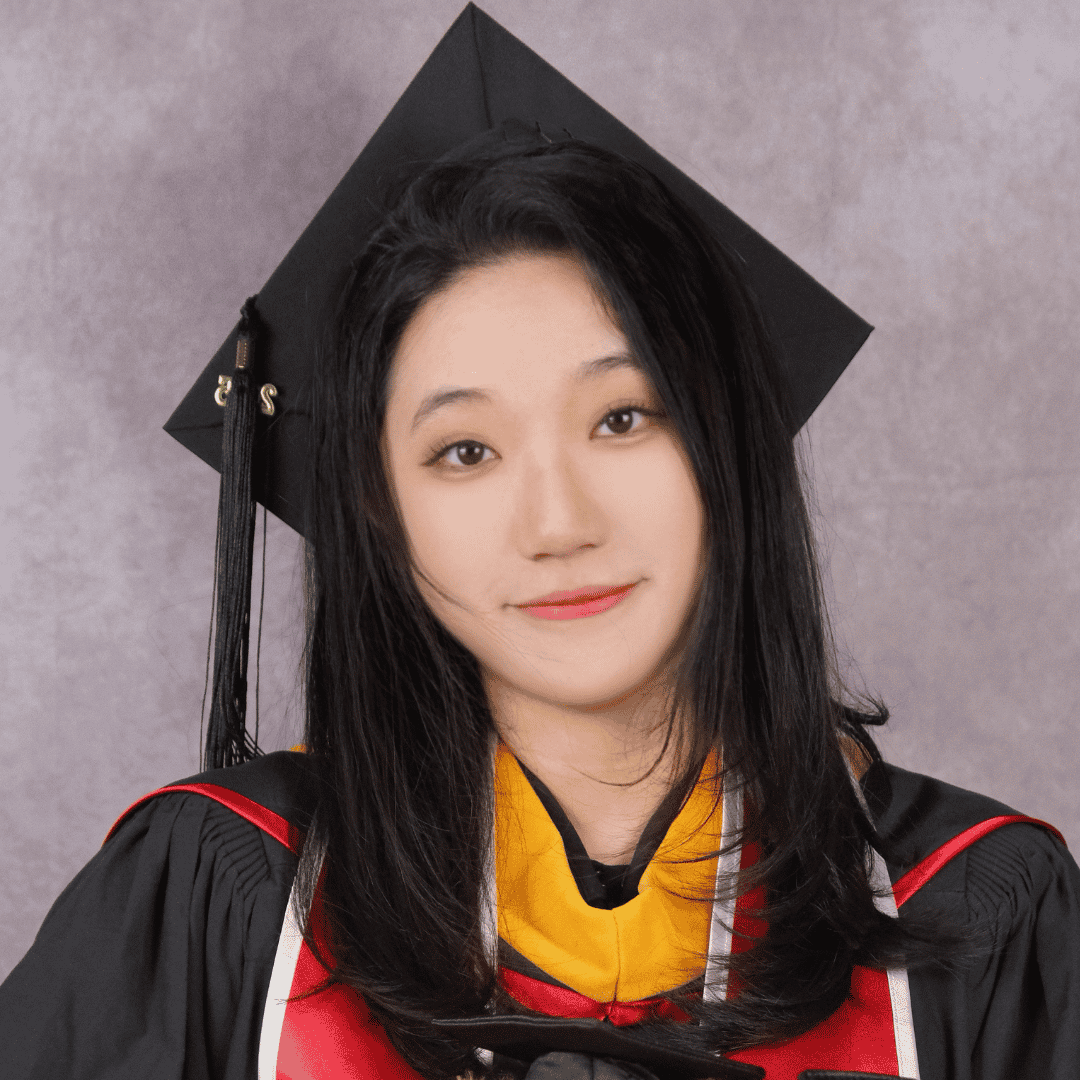
Ruijia Tian’s career goals are shaped by the desire to use informatics to advance clinical care. She received her BS in computer science and artificial intelligence (AI) from Xi'an Jiaotong-Liverpool University, where she developed an interest in programming, data analysis, and computational methods. During that time, she also volunteered to provide care for individuals with autism. Ruijia observed the challenges people faced in communicating their needs and in receiving practical support and long-term care. Consequently, she was inspired to do work that influenced and improved real-world health care communications. In pursuit of that goal, Ruijia obtained her MS in Health Informatics at Weill Cornell Medicine (WCM).
Ruijia grew up in China and saw her master’s degree as an opportunity to meet new people and understand different perspectives. After comparing several programs, she believed that learning at WCM in NYC, amidst a network of renowned hospitals, would be the perfect means to do so. “I also really wanted to focus on interpretable AI,” she explained. “Clinicians need more than black-box AI; they need to understand why tools are making certain predictions, especially if those predictions influence diagnoses.” Given this, the rigorous AI courses offered through the MS in Health Informatics program held additional appeal.
Though the first few weeks of the program presented some challenges, including her course load and new environment, the experience strengthened her independence and ability to manage tasks over time. Among her favorite courses were Artificial Intelligence in Medicine I, taught by Dr. Chang Su, program director of the MS in Health Informatics and assistant professor of population health sciences, and Natural Language Processing (NLP), taught by Dr. Yifan Peng, associate professor of population health sciences. “These courses really helped me understand how, systematically, AI and NLP can be used to analyze complex medical data,” said Ruijia. “We can use these computer science tools to extract meaningful information from big datasets and clinical electronic health records to support clinical decision-making.”
Ruijia also completed her capstone project under Dr. Peng’s supervision. She focused on the use of interpretable AI in medical image analysis, which allowed her to work at the intersection of biomedical science, health data science, and AI. Through this project, Ruijia developed her computational skills, deepened her understanding of large language models, and explored how clinical text could complement medical image analysis.
Similarly impactful was her experience volunteering with Dr. Su. She supported data analysis efforts for Parkinson’s disease research, receiving meaningful training from students in the PhD in Population Health Sciences program on coding and refining outputs. Ruijia believes this was one of the first projects in her academic career that proved she could make a difference and strongly recommends that students in the program seek out volunteer opportunities wherever possible.
Beyond her academic experience, Ruijia deeply valued the professional guidance she received from Miriam Miller, associate director of career development and employer engagement. Together, they reviewed her CV, resume, and LinkedIn profile, which helped Ruijia through any anxieties she had about applying to PhD programs. Miriam helped her break the application process into individual tasks, shared tips for becoming more confident, and offered her insights on how to stand out from other PhD applicants.
Having successfully navigated that process, Ruijia is currently pursuing her PhD in the Integrated Biology and Medicine Program at the Duke-NUS Medical School in Singapore. She is continuing her work on interpretable AI and multimodal health data analysis, implementing the skills from her MS program every day as she lays the groundwork for her career. “My five-year goal is to develop a novel AI method that is both interpretable and can be used practically by clinicians,” she explained. “I want to support more efficient patient care and enable clinicians to be better aware of various care needs.”