

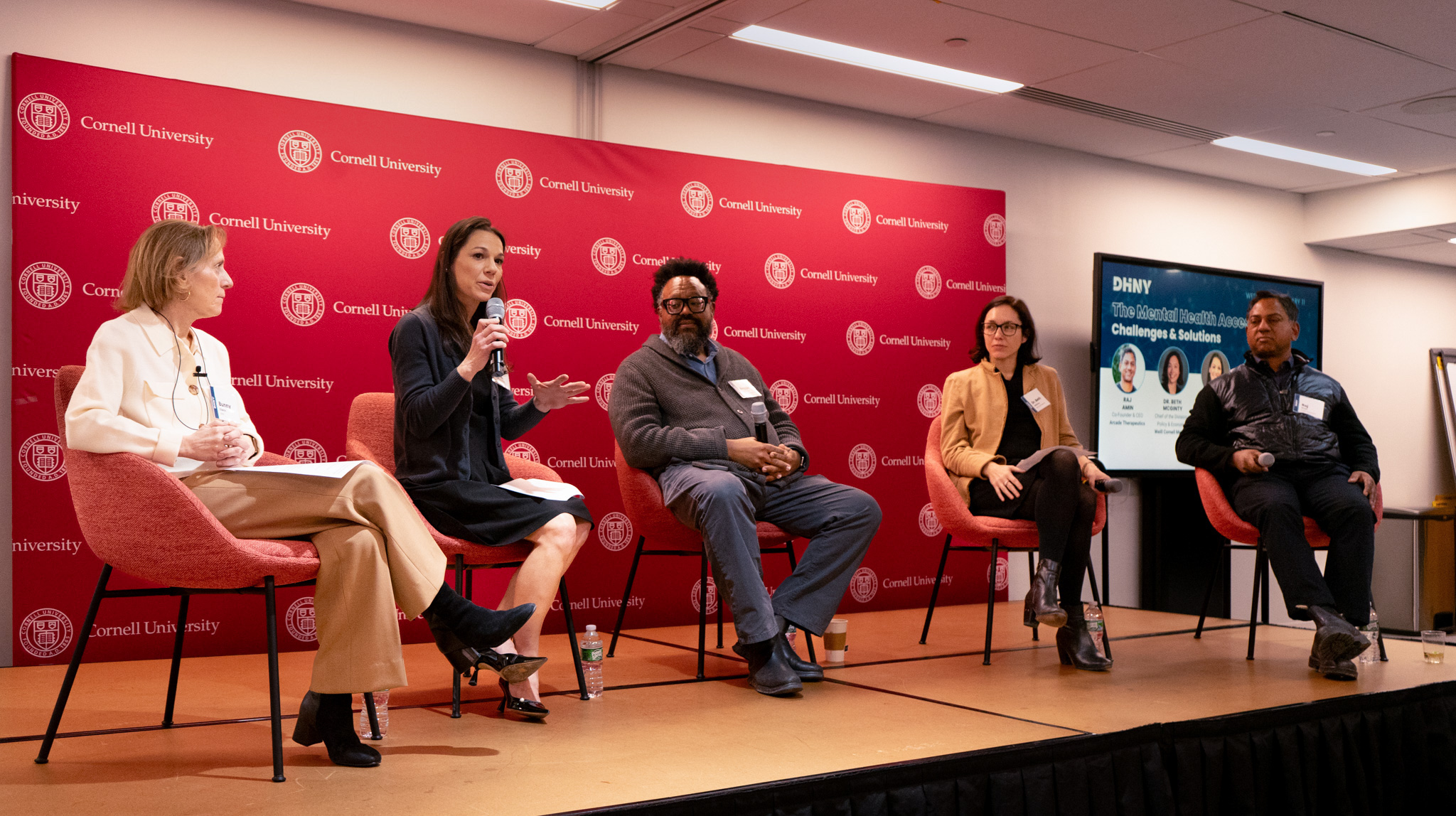
As the mental health crisis in the US persists, the Cornell Executive MBA/MS in Healthcare Leadership program partnered with Digital Health New York (DHNY) to host a panel on “The Mental Health Access Crisis: Challenges & Solutions.” DHNY is a membership organization that brings together senior-level professionals, executives, entrepreneurs, and leaders across New York’s health care ecosystem. DHNY curates experiences that unite and inspire the digital health community. This panel and networking opportunity brought together leaders in health care policy, clinical practice, and other sectors to discuss current barriers to mental health care and explore solutions to improving access.
The panel featured Raj Amin, co-founder and CEO of Arcade Therapeutics, Dr. Beth McGinty, chief of the Division of Health Policy and Economics and co-founding director of the Cornell Health Policy Center, Dr. Amy Racanello, (MBA/MS ‘23), senior clinical neuropsychologist and manager of clinical strategic partnerships at the Child Mind Institute, and Reginald D. Williams II, senior vice president of the Commonwealth Fund. Bunny Ellerin, co-founder and CEO of DHNY, served as the moderator.
Amin, Dr. McGinty, Dr. Racanello, and Williams explored the impact that stigma around mental health, unmet basic needs, social isolation, and affordability have on individuals seeking care. Dr. McGinty, whose research focuses on how health policies affect populations with complex health and social needs, explained, “Historically in the US, we have not had insurance parity for mental health with general, medical, and surgical benefits. For example, you may have unlimited visits covered for care for diabetes, but a visit limit for mental health care.”
Expanding on how insurance influences access to care, Dr. Racanello noted that the current crisis model can be especially challenging for pediatric providers. “For insurance to reimburse a pediatric evaluation, I need to bill that the presenting symptoms are at the threshold for diagnosis,” she said. “Once I see a patient who is presenting with symptoms that cross that threshold, I’m already seeing impaired function. If I had stepped in sooner, there might be fewer symptoms, symptoms might be less severe, and issues would be less treatment resistant.”
The panel also explored the “promises and perils” of integrating technology and artificial intelligence in care, emphasizing the need to bridge gaps in existing care methods and improve the systems currently in place. Williams, whose expertise is in international learning and surveys, discussed models in other countries that have shown potential. “The UK, for example, has a pretty robust system where primary care providers are a first line of defense that can refer people to mental health specialists,” he said. “They can also refer patients to different digital tech and solutions that might be effective, and this step is already built-in to their processes.”
Amin is exploring the use of clinically effective therapeutic games but is also interested in creating efficiency in the health care workforce. “We’re working on collecting data on patients between their appointments and then providing notes to clinicians,” he explained. “These can help recap a patient’s experience in between visits, thus informing where and how physicians should take action.”
While challenges in ethics and scalability remain, the panel expressed optimism about the potential for digital health solutions to make a difference. “We’re still very early in the technology fusion and adoption phase, and it’s important to collect feedback about the provider and patient experience as we determine what the next steps will be,” said Williams. “People that are trying to drive positive change in health care have a real opportunity to share their perspective and voice to make systems better.”
Interested in being a part of the dialogue? Prospective students can learn more about the benefits of the program by attending one of our upcoming events with faculty, staff, alumni, and current students.
The Cornell Executive MBA/MS in Healthcare Leadership Program is a dual-degree program created by two powerhouses in graduate education—the Samuel Curtis Johnson Graduate School of Management and the Weill Cornell Graduate School of Medical Sciences— delivering both an MBA and an MS in Healthcare Leadership in an NYC-based weekend format. Learn more about the program here.
- Highlights