

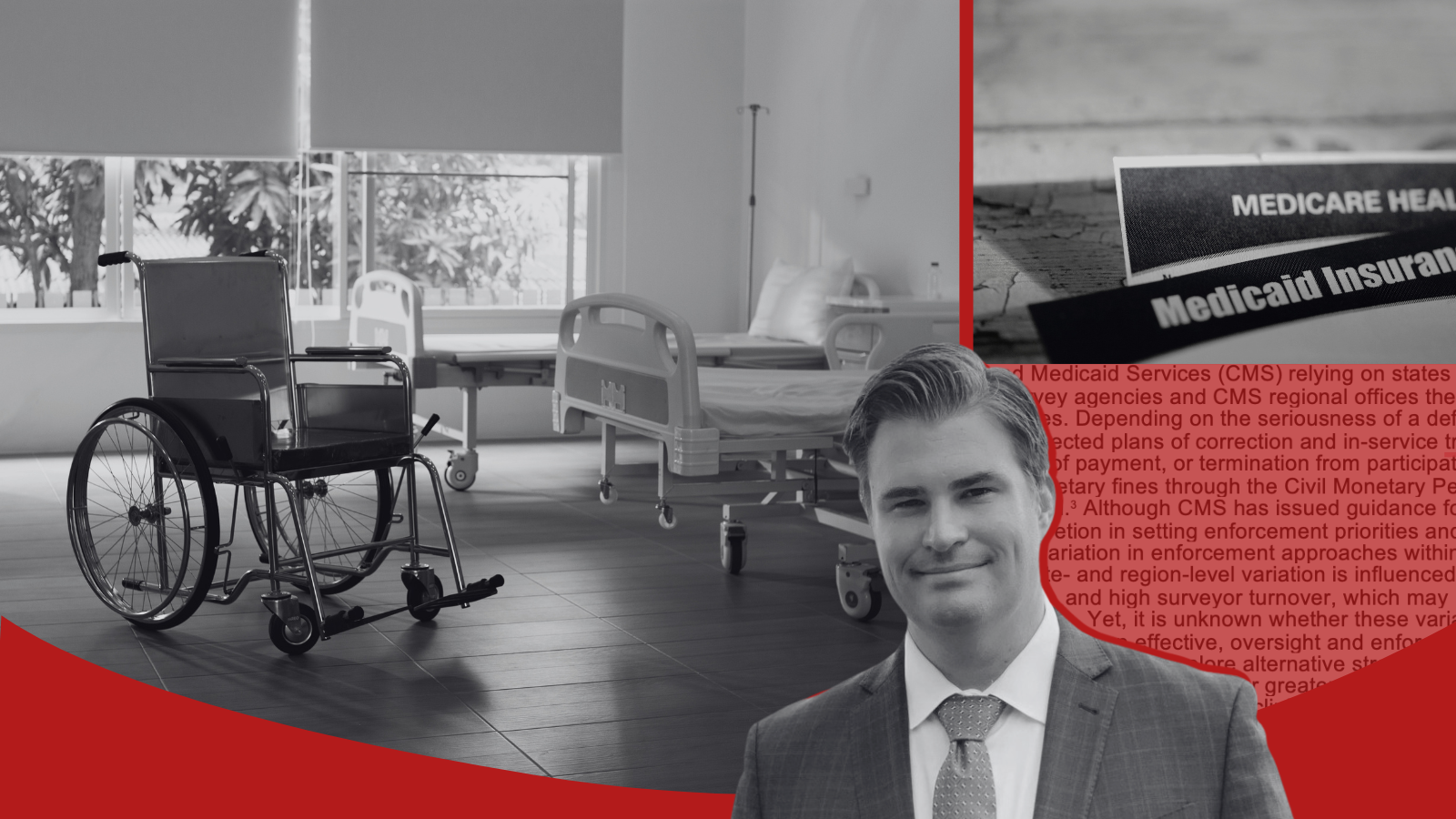
Dr. Robert Tyler Braun, assistant professor of population health sciences, has received an R01 from the National Institute on Aging to study the impact of the Civil Monetary Penalties (CMP) program on nursing home quality of care.
The CMP program is part of the Centers for Medicare and Medicaid Services (CMS) approach to improving nursing home quality and oversight. A recent report by the Senate Aging Committee found that US nursing home oversight and enforcement are in crisis, with Congress allocating less than 80 cents per resident per day for critical oversight activities to ensure high-quality care. States are behind on annual inspections for nearly a third of the nation’s 15,000 nursing homes, and federal underfunding of oversight and enforcement has contributed to severe staffing shortages among surveyors.
CMS relies on individual states to monitor and enforce federal standards, and monetary fines via the CMP program are the most frequently used tool for imposing penalties against underperforming facilities. Since states have discretion in setting enforcement priorities and penalty thresholds, there is significant geographic variation in how CMPs are imposed, but the impact of this variation on the quality of care has gone unmeasured.
“The teams of inspectors conducting nursing home evaluations have different expertise and understandings of what constitutes a deficiency in performance and what justifies a monetary penalty,” said Dr. Braun. “Therefore, enforcement is not uniform, neither within nor across states. If we find bias or inequality in how these nursing homes are receiving CMPs, it exposes a systematic issue within and across states.” Conducted by a multidisciplinary team, this research will be the first to assess the characteristics of nursing homes subjected to CMPs and determine how these penalties influence quality of care for residents.
The mixed-methods project will involve creating a national database of nursing homes and residents from 2011 to 2024 and identifying the characteristics that contribute to performance deficiencies. Dr. Braun’s team will then evaluate whether these deficiencies lead to CMPs, assess how these factors affect the size of fines imposed, and explore the variation in the facilities receiving CMPs. They aim to identify the quality and structural factors in facilities that are more likely to receive CMPs. A difference-in-differences study will be used to compare changes in quality outcomes in nursing homes that received CMPs with those that did not. Finally, Dr. Braun’s team will conduct qualitative interviews with state nursing home surveyors and nursing home leaders from facilities that have faced CMPs. This will inform how they examine specific characteristics of nursing homes in their quantitative analyses.
“A lot of these facilities may already be financially distressed,” explained Dr. Braun. “The money they have to pay for a penalty could have been otherwise reinvested in the facility, rather than being extracted.” He elaborated on this, stating that, with nursing homes operating on very low profit margins and historically poor care, a sizable penalty could have direct implications for the nursing home’s financial situation. “Even ten or twenty thousand dollars could affect how the nursing home is able to staff nurses, and staffing is directly correlated with quality of care.”
Dr. Braun will be collaborating with Dr. David Stevenson, Mike Curb Chair of the Department of Health Policy at Vanderbilt University Medical Center; Dr. David Grabowski, professor of health care policy at Harvard Medical School; Dr. John Bowblis, professor and research fellow of the Scripps Gerontology Center at Miami University; Dr. Beth McGinty, chief of the Division of Health Policy and Economics and co-founding director of the Cornell Health Policy Center; Dr. Jiebing Wen, research assistant professor of health outcomes at The University of Texas at Austin College of Pharmacy, and Rahul Fernandez, senior research assistant in population health sciences.
With the nation’s 1.1 million nursing home residents at risk, Dr. Braun hopes this research will start a productive conversation about the lack of standardization in the CMP program, underinvestment in nursing home evaluations, and the biases and design issues in these evaluations that should be addressed. “This type of work not only affects federal and state policy, but directly influences what happens in nursing home facilities,” said Dr. Braun. “We need to know how to create a more equitable system, whether that means reforming it or designing something new."
- Highlights