

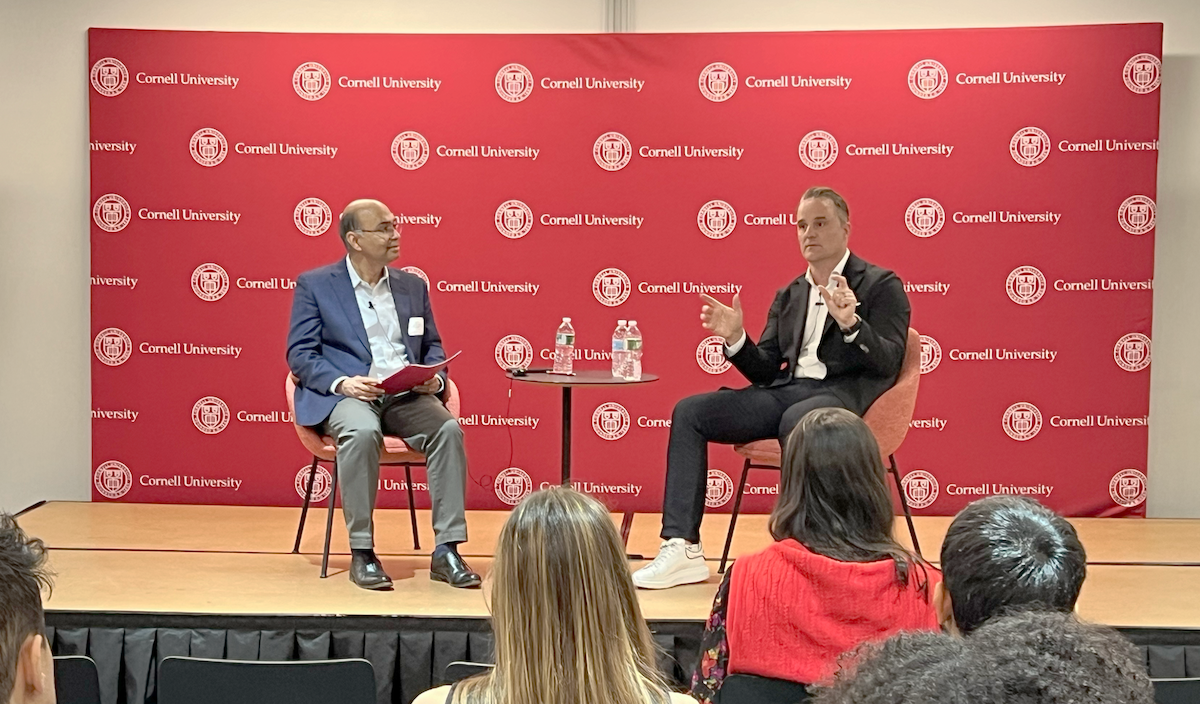
Is leadership an innate trait born to a select few, or a skill that can be nurtured and strengthened over time? What skills are necessary for leadership in a science-based firm? Stewart Campbell, MBA ‘14, believes that leadership is a quality that is not only teachable but also composed of cross-functional domain knowledge, which he learned in his Executive MBA program at Cornell University.
Currently the chief executive officer of Novita, a biopharmaceutical company developing anti-cancer treatments, Campbell has more than 20 years of experience in pharmaceutical operations in both big pharma and smaller companies in the U.S. and Europe. He recently shared his expert insights at a Luminaries in Healthcare Leadership event with Dr. Vishal Gaur, Anne and Elmer Lindseth Dean at the Samuel Curtis Johnson Graduate School of Management at the Cornell SC Johnson College of Business.
Drawing on his own background, Campbell emphasized the shift required when moving from a specialized role into broader leadership. “When you go from a science or health care leadership role into a cross-functional leadership role...what got you to the original leadership role was the subject-matter expertise. Now you have to have translational knowledge across all the functions of business – accounting, finance, strategy, etc. – beyond where your expertise lies,” he related.
“Try to understand how to ask the right questions and trust that people make the right decisions rather than be the person who has to know the answer. There’s an overall leadership maturity that you have to build. I think it's something you can be better at, and you can continue to learn moving forward.”
To further illustrate the demands of a cross-functional leader, Campbell likened it to a translator, interpreting nomenclature from one subject area to another. “I often think about my teams – the finance team, who are worried about profitability and resource sustainability, and the clinical operations team, who need more money, and how to mirror the two intents. It’s my job to make sure that they understand that there’s a common objective and they just speak different languages.”
Campbell also reflected on his career trajectory from working at traditional “big pharma” companies to the more dynamic biotech sector. Highlighting the entrepreneurial mentality ingrained in the industry, he credits much of biotech’s growing success to a sense of ownership: “Rather than clocking out at five, it’s not about time constraints. I’m really invested in this project, and I’m going to do whatever it takes to get that project to the finish line.”
Campbell also spoke with Dean Gaur about the importance of AI skills for today’s MBA graduates and business leaders. As a proponent of leveraging AI tools to drive innovation and momentum, he pointed to three areas where AI has been tremendously helpful: drug development and the identification of molecules; trial design (e.g., building virtual control arms, selecting patient sites, and deriving data and models); and commercialization.
Another central theme of Campbell’s talk was breaking down silos and merging science with business. Pointing to the Cornell Executive MBA/MS in Healthcare Leadership program as a unique model of cross-disciplinary training, he applauded the students’ adaptability and willingness to expand their skillset: “Discounted cash flows was not something that you necessarily studied previously, and suddenly that becomes something you need to understand. I think you've already selected yourselves as wanting to diversify your mentality and increase the sustainability of your career...The ability to build financial business acumen in parallel to your scientific acumen is invaluable.” The event was attended by students and alumni of the EMBA/MS Healthcare Leadership Program as well as healthcare professionals in the wider New York City healthcare industry.
About Luminaries in Healthcare Leadership
Luminaries in Healthcare Leadership series is sponsored by the Executive MBA/MS in Healthcare Leadership program at Cornell University. A collaboration between the Samuel Curtis Johnson Graduate School of Management and the Weill Cornell Graduate School of Medical Sciences, this dual-degree program helps healthcare leaders develop and strengthen their business skills and management capabilities while deepening their understanding of key drivers in the industry.
- Highlights